
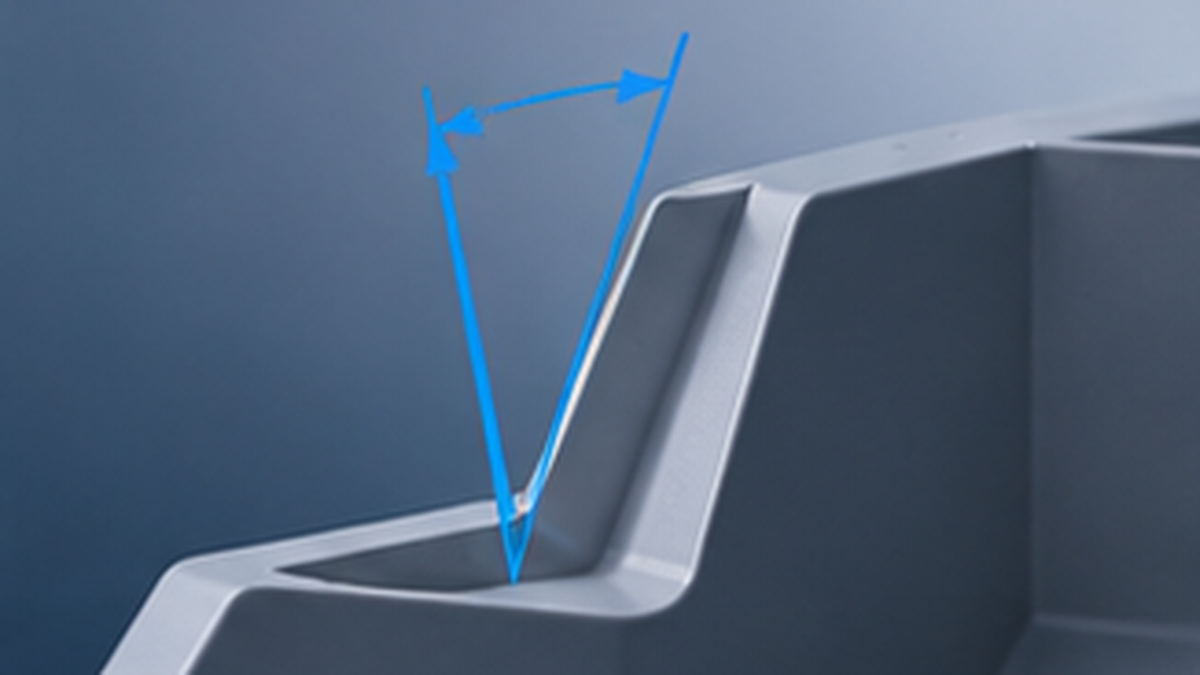
When designing a part for injection molding, it is necessary to consider not only how the product will function but also how it will be removed from the mold. One of the basic design considerations is draft angle.
What Is Draft Angle?
Draft angle is the slight taper added to surfaces that would otherwise be parallel to the direction of part removal. This angle helps reduce contact and friction between the molded part and the mold surface during ejection.
What Can Happen Without Sufficient Draft?
Plastic shrinks as it cools and can grip the core surfaces of the mold. Insufficient draft can lead to drag marks, scratches, deformation, higher ejection force and difficult part release.
Is the Same Draft Used on Every Surface?
No. Required draft depends on part geometry, wall height, plastic material and surface texture. Textured or rough surfaces may require different draft from smooth surfaces. A single angle should not be applied to every project without reviewing those conditions.
Why Does Surface Finish Matter?
Glossy, matte and textured surfaces do not release from the mold in the same way. Deep textures can increase mechanical engagement between the part and the mold, so surface finish should be considered during part design rather than added as an unrelated finishing decision.
The Effect on Deep Walls
As the surface length in the pull direction increases, contact with the mold also increases. Draft becomes especially important in deep boxes, covers and enclosure-type parts.
What If an Undercut Exists?
If geometry prevents direct removal in the mold-opening direction, a standard two-plate mold may not be sufficient. Slides, moving cores or other mechanisms may be required. Draft and undercuts therefore need to be reviewed together, although they are different design issues.
Checking Pull Direction During DFM
Before mold investment, the CAD model should be reviewed for pull direction, vertical walls, undercuts, parting line and critical cosmetic surfaces. This allows problematic geometry to be revised before mold design begins.
Mold Design and DFM at İdeal Plastik
At İdeal Plastik, part geometry and series-production requirements are evaluated together. The goal is not simply to convert CAD into a mold, but to review manufacturability before mold investment.
Conclusion
Draft angle may appear to be a small design detail, but it can directly affect mold construction and part ejection. Insufficient draft can make release more difficult, while an appropriate design supports a more controlled ejection process.
Read our DFM and mold-design guide for a broader manufacturability review, or contact İdeal Plastik to discuss the pull direction and moldability of your part.