
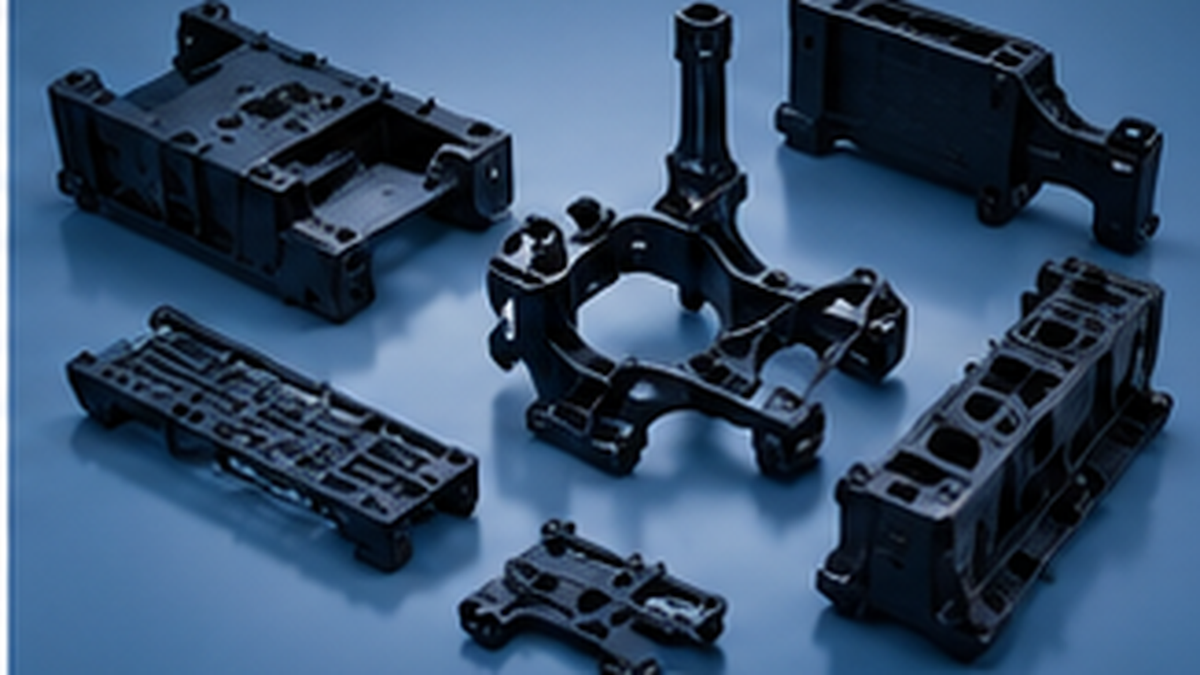
Repeatable dimensions and performance in automotive plastic parts depend in part on decisions made before the mold is manufactured. Design for manufacturability, or DFM, reviews part geometry, material behavior, tooling and the injection process together. Identifying production risks before steel is cut can reduce avoidable changes, while keeping the required function and acceptance criteria in view.
Why DFM should precede mold manufacturing
A CAD model describes the intended geometry, but it does not prove that the part can be filled, cooled and released consistently. DFM reviews the parting line, draw direction, draft, undercuts, side actions, gate position and critical dimensions. Features that complicate production can then be adjusted without changing the required function.
Wall thickness, ribs and transitions
Abrupt changes in wall thickness can increase the risk of sink marks, voids and residual stress. Balanced sections help control filling and cooling. Where stiffness is needed, appropriately designed ribs may avoid unnecessary thick sections. Rib thickness, height and root radius should be evaluated for the selected material, mechanical function and visible surface; one geometry is not suitable for every component.
Runner, gate and cooling decisions
Gate location influences flow direction, weld lines, air evacuation and the visible gate mark. Flow around clips, snap features and mounting holes needs particular attention. Cooling channels should remove heat as evenly as the geometry allows to help control cycle time and warpage. Runner and cooling decisions should reflect annual volume and quality targets as well as initial tooling cost.
Material shrinkage and tolerances
PP, PA6, PA66, POM, ABS and TPE do not behave identically in a mold. Fiber reinforcement, moisture uptake and flow orientation can influence the dimensional result. A general catalog shrinkage value does not by itself establish achievable tolerances. Consider geometry, flow direction, conditioning and service temperature; identify critical dimensions on the drawing and agree their measurement method before sampling.
From first sample to series production
A first shot shows that a part can be molded, not that series production is stable. Review dimensional reports, appearance, assembly trials and any required functional tests. Establish a process window that has been checked against the agreed acceptance criteria. Design, tooling and production teams should work from the same revision-controlled technical data so that modifications and subsequent runs can be compared.
Frequently Asked Questions
When should a DFM review be completed?
After the CAD model is available and before mold steel is machined.
Can the same mold approach be used for every plastic part?
No. The material, annual volume, appearance requirements and functional tolerances can change the appropriate mold structure and production approach.
Is an approved first sample enough for launch?
No. Dimensions, assembly, function and process stability should all be verified.
Prepare Your Project for Production
Since 1982, İdeal Plastik has managed mold manufacturing and plastic injection part production within one production chain. Share your CAD data, material requirement, annual volume and critical dimensions to request a technical project review.
Explore our mold manufacturing and injection molding services or send your project for technical review.