
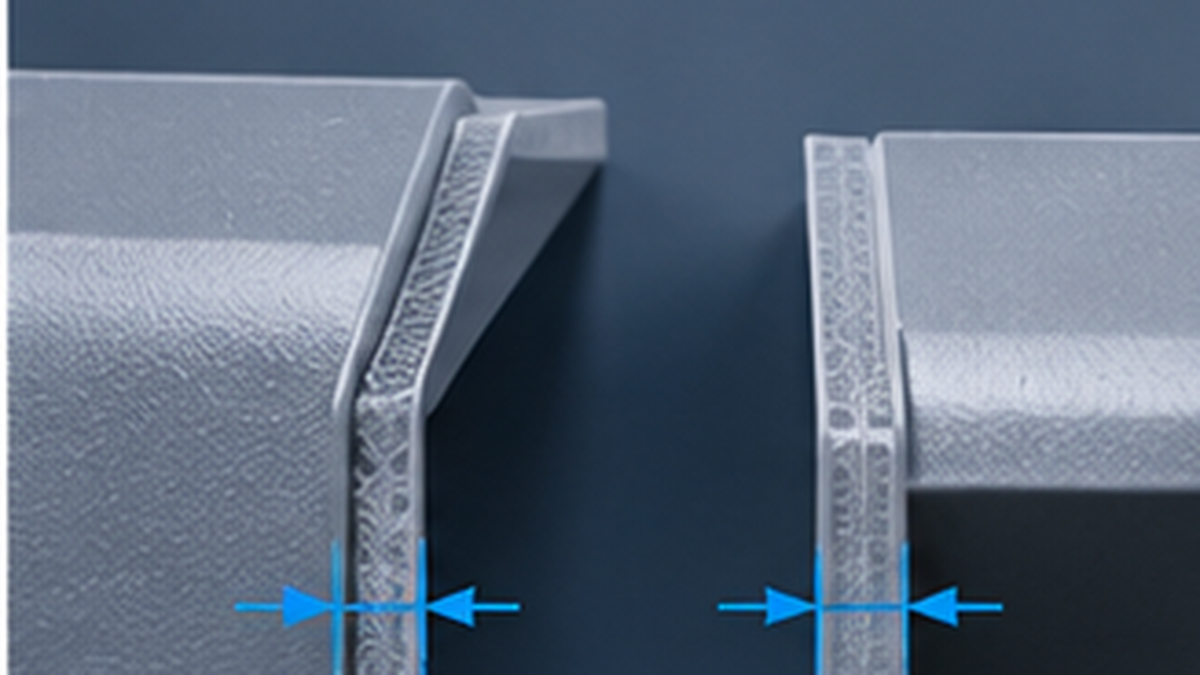
Wall thickness is one of the fundamental design parameters that directly affects moldability and mass-production performance of an injection-molded plastic part.
Correct external geometry alone is not enough. How the plastic flows through the mold, how the part cools and how well it maintains dimensional stability must also be considered during design.
What Is Wall Thickness?
Wall thickness is the material thickness between two opposing surfaces of a plastic part. Large variations in thickness across the part can change both flow behavior and cooling behavior inside the mold.
Why Should Wall Thickness Be Balanced?
Molten plastic enters the cavity and solidifies as it cools. Thicker areas cool more slowly than thinner areas. This can contribute to sink marks, warpage, dimensional changes, internal stress and longer cooling times.
What Can Happen in Very Thick Sections?
The center of a thick section cools later than the outer surfaces. As the outer surface solidifies, the material inside continues to cool and shrink, which may cause visible sink marks and longer cycle times.
What Can Happen in Very Thin Sections?
In very thin sections, molten plastic may cool faster and flow may become more difficult. This can increase the risk of incomplete filling or more demanding processing conditions. For long flow paths, wall thickness, material and gate location should be evaluated together.
Sudden Thickness Changes
A sudden transition from a thin to a very thick section can create abrupt changes in cooling behavior. For this reason, not only average wall thickness but also how thickness is distributed throughout the part matters.
Using Ribs
Increasing wall thickness is not always necessary to improve stiffness. Properly designed ribs can support mechanical performance without unnecessarily increasing part weight or creating thick sections. However, overly thick ribs may cause sink marks on the opposite surface.
Plastic Material Also Matters
PP, ABS, PA, POM, PC and other plastics have different flow, shrinkage and cooling characteristics. There is therefore no single ideal wall thickness that applies to every project.
How Does Wall Thickness Affect Mold Design?
Wall thickness is related to runner and gate design, cooling, injection pressure, cycle time, shrinkage and flow behavior. It should be considered as part of the complete part-and-tool concept rather than an isolated dimension.
Why Is DFM Review Important?
A design-for-manufacturing review evaluates wall thickness, pull direction, critical surfaces, assembly areas and geometries that may complicate the mold. A small design change made early can prevent a much larger mold revision later.
Part and Mold Evaluation at İdeal Plastik
At İdeal Plastik, injection mold projects are not evaluated only from the existing CAD geometry. Part function, plastic material, production volume, critical dimensions and series-production conditions are considered together with the mold concept.
Conclusion
Wall thickness is one of the most important parameters in plastic part design. Sections that are too thick, too thin or change abruptly can affect filling, cooling, sink marks and warpage.
Explore material selection and DFM and mold design, then request a technical review of your new part.